 is embedded in a
rectangle
is embedded in a
rectangle
 .
Parameters
.
Parameters  ,
,  ,
,  and
and  are given
in ASSEMBLE/problem_setup.m.
are given
in ASSEMBLE/problem_setup.m.
| Start page of documentation | Download the code | Documentation: PDF, PS |
| Previous: EJIIM idea | Next: Discretisation in a rectangle |
The original domain is embedded in a
rectangle
.
Parameters , , and are given
in ASSEMBLE/problem_setup.m.
After embedding, the original domain becomes
a `-' phase  and the rest is typically
denoted by `+' phase
and the rest is typically
denoted by `+' phase
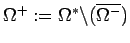 .
The boundary
.
The boundary
 becomes an interface
and boundary conditions turn into jump conditions.
The extension is done by zero in
becomes an interface
and boundary conditions turn into jump conditions.
The extension is done by zero in  , thus, on
 homogeneous Dirichlet boundary
conditions can be imposed.
homogeneous Dirichlet boundary
conditions can be imposed.
Attention:
The embedding rectangle has to be selected in such a way
that there is ``enough'' space between
and
. ``Enough'' depends on the mesh width used in
discretisation. In any case, there should be at least several layers
of grid points between
and
.